Case Study
Multi-Agent Monitoring for Factoring Underwriting
Softwise.AI partnered with a factoring company (under NDA) to co-create a modular, agent-based AI system that automates the collection, monitoring, and reporting of online company information across the underwriting portfolio. By orchestrating specialized agents to search different sources, compare findings to prior reports, and generate actionable alerts and summaries, the underwriting team can now support factoring decisions at scale - turning hours of manual research per client into under two minutes of automated, structured reporting.
CLIENT
Confidential (under NDA)
YEAR
2025
INDUSTIRES
Financial Services - Factoring & Credit Underwriting
DELIVERABLES
Agent-Based Monitoring System, Configurable Search Agents, Master Aggregation Agent, Automated Reporting, CRM & Credit-System Integration, Secure Cloud Deployment

The problem
The client's underwriting team needed continuous, reliable visibility into the online footprint of every company in its factoring portfolio - corporate filings, leadership changes, customer and employee sentiment, regulatory notices, and any emerging signal that might affect credit risk. In practice, that meant analysts running the same kind of fragmented internet research, manually, across thousands of companies, every cycle.
The work didn't scale. Sources were spread across platforms with inconsistent timestamps, important signals slipped through, and consolidating findings into a usable report cost hours per client - slowing credit decisions and eroding the team's ability to expand the portfolio. The team needed a way to automate the entire research-to-report loop, with enough flexibility to add new sources and risk signals as the business evolved, and without compromising on the security of credit data.
Softwise.AI was asked to co-create that system in close collaboration with the underwriting team.
{Key Challenges}
Why manual online research couldn't scale across a factoring portfolio
The project had to address a tightly interlocked set of operational, data, and security constraints:
High monitoring volume
The portfolio contained too many companies for individual analyst searches to remain practical or repeatable.
Fragmented data across online platforms
Relevant information lived across many sources, often without clear timestamps - making it hard to know what was new and what mattered.
Risk of missing emerging issues
Negative customer reviews, employee complaints, regulatory notices, and other early-warning signals could easily slip past manual review under time pressure.
Hours of manual consolidation per client
Pulling research together into reports consumed senior underwriting time and delayed credit decisions.
Constantly evolving monitoring needs
New data sources, sectors, and risk patterns kept emerging - any solution had to adapt without an engineering project each time.
Confidentiality of credit data
As a financial services provider, the client needed enterprise-grade security, controlled deployment options, and tight integration with existing CRM and credit-decision systems.
{Process}
How we co-created a multi-agent monitoring system in 5 stages?
Softwise.AI and the client ran the engagement as a true co-creation, with the underwriting team actively shaping the system at each step.
1. Joint discovery with the underwriting team
The teams worked together to map the real research workflow, identifying which signals actually moved credit decisions, where analysts were spending most of their time, and what an acceptable report looked like for the next reviewer in the chain.
2. Designing an agent-based architecture
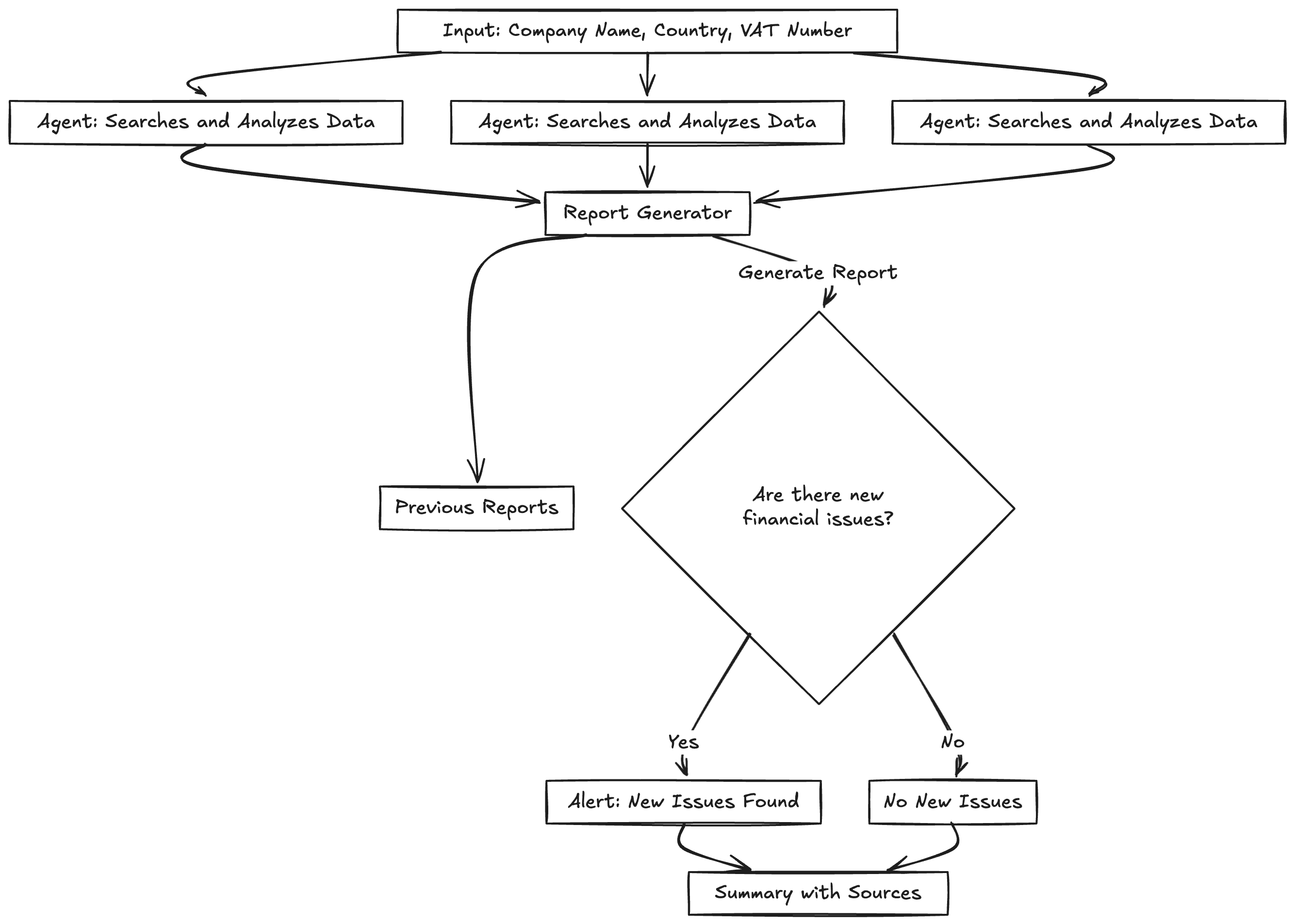
Rather than building a single monolithic model, the team designed the solution as a suite of specialized AI agents - each responsible for a distinct part of the research pipeline, coordinated by a master agent. This made the system modular, testable, and easy to extend.
3. Configuring search agents to the client's risk model
Working with the underwriting team, Softwise.AI configured a tailored set of Search Agents covering the client's highest-priority data categories - corporate profile, sentiment, compliance, and custom industry-specific signals - with criteria, sources, and priorities defined per agent.
4. Building the aggregation and reporting layer
The Master Agent was designed to aggregate raw outputs from the Search Agents and compare current findings against the previous report - so each cycle highlights what changed, not what stayed the same. A Reporting Agent then turns that data into a concise, decision-ready summary.
5. Security and integration framework
In parallel, the team built the enterprise plumbing: hybrid deployment options, integrations with the client's CRM and credit-decision systems, and zero-retention guarantees on source documents beyond what is needed for report generation.
Solution
The system is built as a coordinated suite of specialized AI agents, each responsible for one step in the research-to-report pipeline - moving from raw web sources to a concise, change-aware report that an underwriter can act on.
Search Agents
A pool of autonomous agents runs in parallel across the data sources that matter to the client's underwriting decisions. The framework supports unlimited agents, added or removed on the fly to match evolving monitoring needs:
Corporate Profile Agent - pulls business basics, leadership changes, and major announcements.
Sentiment Agent - tracks customer reviews, employee comments, and public opinion.
Compliance Agent - flags legal filings, regulatory notices, and sanctions.
Custom Agents - spot niche or industry-specific risk signals defined by the client.
Master Agent
Acts as the digital coordinator of the underwriting research loop - aggregating raw outputs from all Search Agents and comparing current findings to the most recent report, so new or changed items surface automatically.
Reporting Agent
Generates a concise summary report highlighting new issues, trends, and risk indicators - sized for human review rather than raw data dumps.
Configurability without IT intervention
The system was designed to evolve with the client's risk criteria:
Unlimited Search Agents can be added for new data sources.
Alignment with jurisdictional compliance rules and internal credit policies.
Custom search criteria per agent.
Priority hierarchies for the signals that matter most.
Enterprise-grade security and integration
The platform supports flexible deployment depending on the sensitivity of the queries:
Public API for non-sensitive queries, or private cloud instances for confidential monitoring.
Integration with the client's CRM and credit-decision systems.
Zero retention of source documents beyond what is needed for report generation.
{Results}
From hours of research to under two minutes per company
The collaboration produced a working, fully designed agent-based monitoring system, validated on a sample portfolio. While the solution is being validated through joint testing rather than running at full production scale, sample-portfolio testing demonstrated:
Research time collapsed - from hours of manual research to under two minutes per company.
Early detection of risk signals - incremental monitoring catches negative reviews, regulatory notices, and other emerging issues before they surface in the credit decision.
Consistent, unbiased summaries - results unaffected by analyst fatigue or time pressure.
Massive scalability - capacity to monitor thousands of companies daily.
A configurable agent framework - new sources and risk signals can be added without engineering work.
A security-ready deployment model - public-API and private-cloud options aligned with the client's confidentiality requirements.
{Business impact}
Underwriters refocused on analysis, not data collection
From reactive to proactive risk visibility. Continuous monitoring catches signals that manual cycles would have missed - or caught too late.
Faster credit decisions. Research-to-report time falls from hours to minutes, removing a key bottleneck in the credit pipeline.
Senior underwriting time refocused. With data collection automated, analysts spend their time on judgment and high-value risk analysis rather than fetching and consolidating sources.
Portfolio growth without proportional headcount. Daily monitoring of thousands of companies becomes operationally feasible.
Security posture preserved. Hybrid deployment, zero retention beyond reporting, and tight CRM/credit-system integration keep sensitive credit data under the client's control.
{Key recommendations}
5 principles for agentic AI in credit monitoring
A few principles emerged from the project that apply to any organization automating continuous research and risk monitoring:
Use specialised agents, not one mega-model. A pipeline of focused agents (corporate, sentiment, compliance, custom) is easier to test, easier to improve, and easier to explain to risk and compliance reviewers than a single opaque system.
Make the diff the headline. Comparing each cycle to the previous report - and surfacing what changed - is what turns continuous monitoring into actionable risk intelligence, not a daily firehose.
Co-create with the people doing the analysis. Which signals matter, which sources to trust, which patterns indicate real risk - these are subject-matter decisions, not engineering ones.
Engineer configurability over hardcoding. Risk signals evolve. A framework that lets the team add a new agent on demand is worth far more than a system shipped with a fixed list of checks.
Treat retention as a design choice. Zero source-document retention beyond reporting is a feature, not a constraint - it makes the system easier to deploy in regulated credit environments.