Case Study
Automating Loan Application Verification for a Regional SME Foundation
Softwise.AI partnered with Fundacja Rozwoju Śląska (the Silesian Development Foundation), a non-governmental organization that provides preferential loans to small and medium-sized enterprises in southern Poland, to redesign its loan application verification process. Through a Discovery-led engagement, the team mapped the existing workflow, identified the operational bottlenecks slowing loan approvals, and designed an AI bot concept capable of automatically verifying applicant data across 15 government and commercial registries - alongside a redesigned, user-friendly application form.
CLIENT
Fundacja Rozwoju Śląska
YEAR
2023
INDUSTIRES
Non-Profit, SME Financing & Preferential Lending
DELIVERABLES
Discovery & Process Analysis, AI Bot Concept for Loan Verification (15 Registries), UX-Redesigned Application Form, Implementation Roadmap with Budget and Timeline
The problem
The Silesian Development Foundation - a non-governmental organization established in 1992 to support the social, economic, and cultural development of regions in Poland inhabited by people of German descent - provides preferential loans to small and medium-sized enterprises across the region. Each loan application has to be verified against multiple public and commercial registries before it can be approved, and that verification was being done by hand.
In practice, that meant Foundation staff spending several hours per application, manually checking data across CEIDG, the Land and Mortgage Registers (KW), KRS, BIK, and other databases. Document management - file naming, attachment handling, archiving - was also manual, leading to inconsistencies and recurring errors. On the applicant side, the form itself was long, complex, and unintuitive, discouraging users and producing incomplete submissions.
Softwise.AI was asked to help the Foundation identify the critical bottlenecks in this process and propose a concrete, costed solution to automate the verification work without compromising the rigor a public-funding institution requires.
{Key Challenges}
Why manual verification across 15 registers slowed every loan decision?
Joint Discovery workshops surfaced a clustered set of operational and user-experience problems:
Low operational efficiency
The verification process required extensive manual work, taking several hours per application - checking data across multiple databases such as CEIDG, KW, KRS, and BIK. Document management (file naming, archiving) was equally manual, producing inconsistencies and consuming significant staff time.
Long, complicated application forms
Forms were overly long and complex, discouraging users and producing incomplete submissions. Data entered during registration was not transferred to the actual application, forcing applicants to re-enter the same information.
Missing user feedback and unclear states
The absence of email confirmation after submission - and non-intuitive draft-saving behavior - left applicants uncertain whether their submission had succeeded.
No standardization for attachments
There were no unified rules for required attachments. The list was unclear, with no explicit indication of which attachments were mandatory and which were optional.
System errors and friction
Technical issues - duplicate attachment fields, missing user instructions - added avoidable friction throughout the process.
{Process}
How we ran a Discovery phase in 4 stages, from review to approved roadmap?
Softwise.AI delivered the engagement as a structured Discovery, building from documentation review through stakeholder interviews to a stakeholder-approved roadmap with budget and timeline.
1. Initial analysis
The team conducted a detailed review of the documentation and existing applications used by the Foundation, building a comprehensive picture of current processes and the dependencies between systems.
2. In-depth analysis with stakeholders
A series of interviews, workshops, and meetings with stakeholder groups gathered insights on the daily challenges in the current work environment, key issues in knowledge management, and functional and non-functional expectations for the future solution. The findings were summarized in a report covering current challenges and initial directions.
3. Target solution analysis
Based on collected insights, Softwise.AI designed possible solutions tailored to the Foundation's needs - presenting process optimization in three variations differing in scope, estimated cost, and implementation timeline. Consultations across stakeholder groups ensured coherence and relevance.
4. Approval
The Discovery closed with a comprehensive report presented to all stakeholders, covering the full analysis of current processes, recommendations for tools and methods, and detailed budget and timeline estimates. An approval session refined the final recommendations against direct stakeholder feedback.
Solution
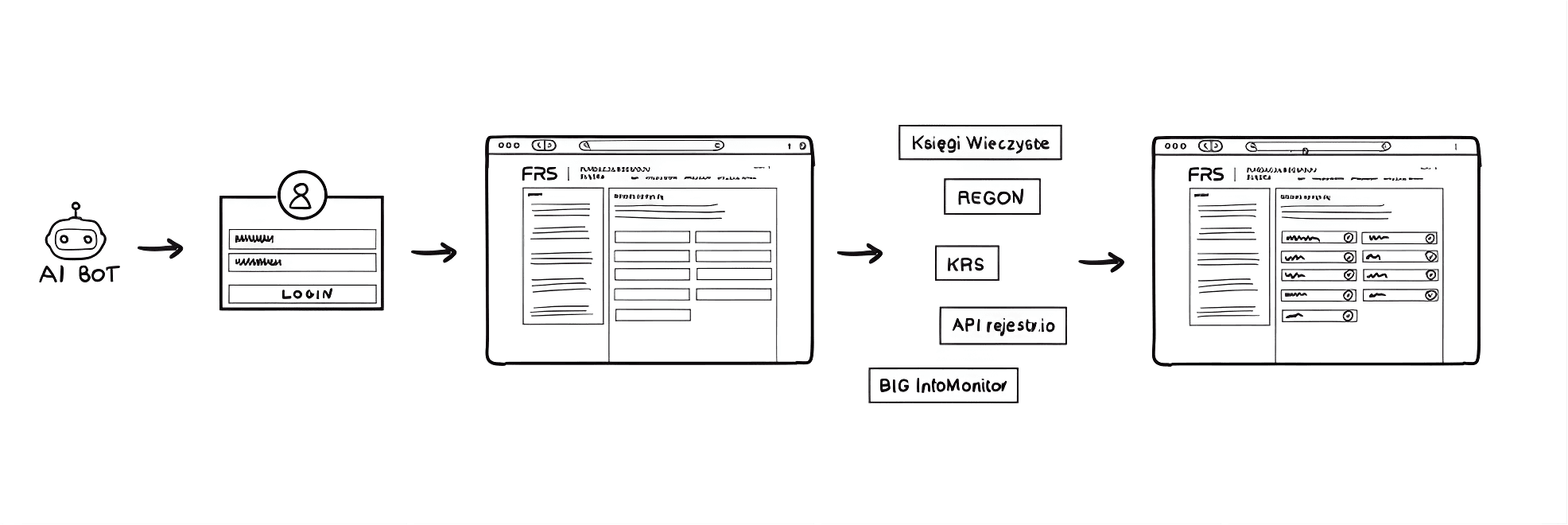
At the core of the proposal is an AI bot that automatically verifies data in loan applications using government and commercial registries - eliminating manual labor and ensuring consistent, auditable verification across systems.
Browser-based operation
The bot operates within a web browser, enabling it to search government websites and other registries directly - including locations that have no public API. This is what allows verification to be automated even where formal integration isn't available.
Integration with 15 systems and databases
The proposed solution integrates with 15 key systems, including the Land and Mortgage Registers (KW), REGON, the National Court Register (KRS), BIG InfoMonitor, and the rejestr.io API - covering the registries that actually drive loan-eligibility decisions in Poland.
Automated behavior on websites
The bot performs sequences of actions automatically: logging into systems on behalf of the user where required, navigating to the right sections, filling input fields, checking and unchecking boxes, selecting options, and clicking buttons like "Search."
Screenshot generation and cataloging
During verification, the bot captures screenshots of relevant subpages and sections - critical for assessment - and saves them in dedicated folders, automatically cataloged. The applicant's file thus contains an auditable trail of every check.
Operations on Excel files
The bot can also open, process, and capture screenshots of Excel files containing verification results - extending automation into the spreadsheet-based parts of the workflow.
Clear results in the user interface
Verification results are presented to Foundation staff in a clear UI: a summary of key data, visualization of verification status (e.g. whether all required checks passed), and one-click access to the generated screenshots.
Automatic data entry into the central system
Once verification is complete, the results are written automatically into the Foundation's central system - eliminating manual data entry by staff and the errors it produces.
Error handling and resilience
The system is designed for real-world conditions: long response times from external registries, query blocks imposed by source systems, and inconsistencies in data format. The bot monitors errors, logs them, attempts to resolve them automatically, and escalates critical issues to an administrator.
A redesigned application form
Alongside the bot, Softwise.AI proposed a redesigned application form addressing the UX issues identified in Discovery: a simplified structure with clear sections, a progress indicator, and automatic data filling - significantly improving the ease and completion rate of the application process.
{Results}
An AI bot concept covering 15 registries and a redesigned application form
Because this engagement was a Discovery, the outcomes are concrete, decision-ready artifacts the Foundation now owns:
A full analysis of current processes and systems, including the specific operational bottlenecks in loan verification and the UX issues degrading application submissions.
A designed AI bot concept capable of browser-based verification across 15 government and commercial registries (KW, REGON, KRS, BIG InfoMonitor, rejestr.io and others), with screenshot capture, Excel handling, automated data entry, and error handling.
A redesigned application form with clear sections, progress indicator, and automatic data carry-over from registration.
Three solution variations differing in scope, cost, and timeline - giving the Foundation board real choices, not just a single recommendation.
A detailed budget and timeline for the recommended path.
A stakeholder-approved roadmap ready to move into implementation.
{Business impact}
Hours of manual verification replaced by automated, cross-registry checks
Process automation. Real-time data verification in external systems and instant report generation replace multi-hour manual workflows.
Major time savings. Automatic verification across 15 registries means staff stop logging into the same set of registers, one application at a time.
Error reduction. Automated file naming and streamlined document archiving directly attack the inconsistencies and small errors that accumulate in manual processing.
Better experience for SME applicants. A simpler, clearer application form raises completion rates and lowers the support burden on Foundation staff.
Audit-ready verification trails. Every check is documented with an automatically cataloged screenshot - useful both for internal review and for the controls a public-funding institution must withstand.
{Key recommendations}
5 principles for automating verification-heavy public-funding processes
A few principles emerged from this engagement that apply to any organization automating multi-registry verification workflows under public scrutiny:
Start with Discovery, not tools. A clear map of the current process - and a real conversation with the people doing the work - is what separates an effective automation from an expensive miss.
Use browser-based automation where APIs don't exist. Many critical Polish public registries have no API. A bot that drives the website is often the only way to automate verification without waiting on someone else's roadmap.
Capture screenshots, not just data. In a regulated lending context, auditability is a feature. Storing a timestamped image of each verification check is what makes the system usable in oversight.
Offer the board variants, not a single answer. Three costed options differing in scope and timeline give stakeholders a real decision to make, not just an estimate to approve.
Fix the form, not just the back office. Automation behind the scenes only works if the data coming in is clean. Application UX is part of the verification system, not a separate problem.
SUMMARY
Softwise.AI delivered a full Discovery for Fundacja Rozwoju Śląska, turning a slow, manual loan verification process into a concrete, costed plan for an AI bot capable of cross-registry verification across 15 government and commercial systems - alongside a redesigned, user-friendly application form. With three solution variations, a detailed budget, a clear timeline, and a stakeholder-approved roadmap, the Foundation has exactly what it asked for: a defensible path to faster, more reliable loan processing without compromising the rigor of a public-funding institution.
TESTIMONIAL
I would like to express our complete satisfaction with our collaboration with Softwise.AI in identifying opportunities for artificial intelligence and optimizing business processes to improve the efficiency of our organization at both strategic and operational levels.
Under the leadership of Jan Nowak, Softwise.AI demonstrated a deep understanding of our business needs, conducting thorough analysis and providing effective solution proposals. Your professionalism and dedication to meeting our requirements were critical to the project's success.
The results of your work, including the loan application process analysis and the recommended optimization directions, fully met our expectations, offering a clear path to improving our operations. With full confidence, I recommend Softwise.AI as a reliable partner for process automation projects. Your expert knowledge and client-focused approach guarantee a high-quality collaboration.
Henryk Wróbel
President, Silesian Development Foundation